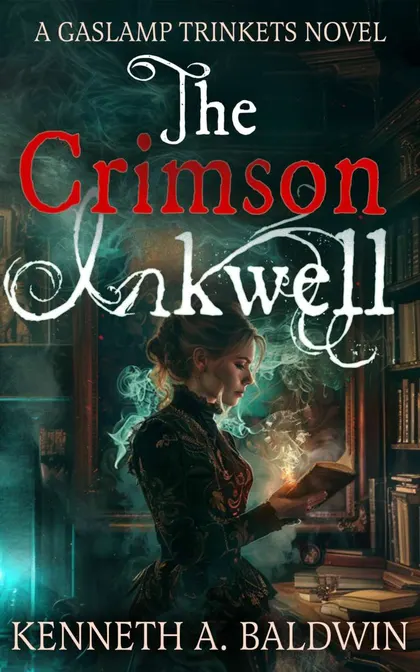
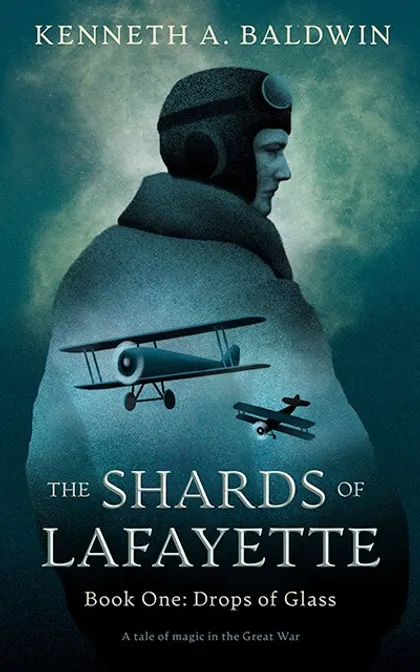
An Exclusive Preview of The Crimson Inkwell: A Gaslamp Trinkets Novel
Chapter 1: Et Tu, Brutus
Critics are evil monsters. On a closer read of Dante, it isn’t difficult to find a remote, special place for their breed among the lower levels of hell. They’re somewhere right between fraudsters and heretics. It’s worth noting that Eve, when taking a bite of that forbidden fruit, did so only at the annoying, incessant insistence of a critic.
Thus, I feel my disappointment justified when, on reaching the bright red door of Langley’s Miscellany for my morning debrief with Byron Livingston, I happened across one of these vile creatures. On the outside steps, he tipped his hat to me as if to say “good-day.” But if he considered the day good, he must have already, at nine in the morning, gutted at least one poor journalist. And, seeing as Langley’s was the publication for which I wrote, I was nearly certain that journalist was me.
I shuffled through the door and shivered. Inside, I could feel the autumn chill that possesses those buildings too frugal to burn coal in September. Sure enough, Byron, my betrothed and editor, had not yet taken off his coat. He stood near his office, staring pensively at his prized skylark, which rested quietly on a wooden perch in its wire cage. I could tell he was troubled. The wrinkles in his eyebrows, already deep set for a man in his forties, still held their crease from the morning’s vexations. No doubt, he had been stewing over whatever Brutus, the loving name I’d lent to our most regular critic, had to say.
Byron rarely showed me his troubles. In fact, I treasured the moments when I happened upon him like this. It reminded me that he, like me, might not always be the picture of polite happiness. The moment vanished as he noticed me enter, and he gave me a broad smile under his large mustache.
“Luella, good morning,” he said, standing to grasp my hands. The coat fell to the floor, revealing a herringbone waistcoat. “You look radiant. I love the way you’ve done your hair.”
That had to be a lie. I looked perturbed, and my hair, somewhere between dark brown and red, had hardly seen a brush that morning.
“What did Brutus want?” I asked.
“Brutus? I haven’t the foggiest—oh right! I forgot your pet name for our friend—”
“He’s not our friend,” I cut in. “Is he?”
“Why not sit down for some tea? Mrs. Barker just brought over some biscuits from down the street,” he said, motioning to the cramped editing table. The two same tired teacups sat there waiting to go through their same old routine. In fact, everything about the office looked about the same as it always did. The small, spent fireplace sat in a corner across from Byron’s small office, which was nearly tucked out of sight. Old, weathered, wood wainscoting came waist-high on the walls. The windows, though dirty, let in an abundant portion of the morning light. Pages were strewn on chairs, tables, windowsills and the floor, which didn’t enjoy nearly enough rug.
“Why must you always draw out bad news?” I asked.
“I don’t intend to. I just believe the world is far more pleasant when viewed over the rim of a teacup,” he replied, pulling out a chair with an encouraging grin. The scraping of the chair woke up the bird, which eased into a few attempts of its practiced song.
I took off my gloves and sat down, pursing my lips as he slowly poured the tea. Byron Livingston. The man who took a chance on me, a twenty-five-year-old woman. When I met him, he was full of life and energy, even for a man past forty. He had a passion for journalism and economy and, by the way he had talked, would soon become the very wealthy owner of a popular weekly magazine. However, the intricacies of the publishing business weren’t as favorable as he anticipated, and now he seemed to grow older every day as he toiled to publish his weekly. Langley’s Miscellany. He made out alright, but I wasn’t expecting an estate of our own after the wedding. In fact, I wouldn’t be surprised if we moved into the rundown flat above the publishing house where he lived now. “Until business improves, as it surely will!” he always tittered on whenever I expressed concern about his finances and their future.
Until business improved, indeed. Brutus had our jugular in a vice grip.
“Well?” I spat out, breaking the tea-time tranquility.
“Well, how is your sister?” he asked, taking a sip.
“She has a bit of a cough. Who doesn’t? It’s midway through autumn.”
“The poor dear. What a lovely blouse you’re wearing. Is that the one I bought for you?”
It wasn’t, and I hardly looked any different than I did any other day. I wasn’t big on fashion. I liked my clothes to be attractive but practical. My sister, on the other hand, made herself presentable even when on her sickbed.
“Of course. It goes so well with my grey waistcoat and skirt. Now will you tell me what Brutus said or not?”
He stiffly replaced his teacup. “Well, if it’s all business then. Mr. Blakely,” I winced as he used my pseudonym, “you’re right. It wasn’t a friendly call.”
“How bad?”
“It wasn’t all bad. In fact, he didn’t hate it. What was the word he used? He said he was… indifferent.”
The word knocked the wind right out of me. “Indifferent?”
“Neither here nor there,” Byron said. “Not good and not bad.”
“You said it wasn’t bad,” I stammered. “Indifferent is the worst type of bad. All our hard work might as well just be letters and words printed on a paper napkin. Neither here nor there? That someone might pass it in the street and walk on, or worse! That someone might actually take the time to read my piece but then go on and never think of it again?”
“You’re getting yourself riled up, my dear,” he said. “Have a biscuit.”
I did not want a biscuit, but I took one.
“Byron, do you agree with him?”
He set down the biscuits and stood up. He leaned against the window and lit his pipe, taking a deep drag on it. The smell of the tobacco reminded me of my father. My father had sacrificed much so that I might be educated. The first time I published an article, I took the printed edition to Papa’s sickbed. I helped him read it, and when we finished, tears streamed on his cheeks into his whiskers. I’d only seen my father cry once. He died a week later.
“I’m so very fond of you,” Byron started. “I continually try to check this sentiment so that it doesn’t seep into our relationship as author and editor.”
“And you know I appreciate that,” I said.
“Sometimes I fear that my, well, my feelings for you sway my objectivity. But, I’ll be damned if the man that came in here this morning was right. You are a fantastic writer. If there is fault, it must be found elsewhere. I am to blame.”
Inside of me, I felt Byron was speaking absolute nonsense, but I’m not one to stop a man from spouting out his own crude type of love poem. Even if it is ill-timed.
“You report on the stories I suggest,” he continued. “And, since Langley’s Miscellany is a smaller publication, we don’t get the same tips and leads as the bigger papers. I’m ashamed to say it. I’m failing you, my darling.”
Personally, I find this type of humility not a little grating and disingenuous. Perhaps Byron spoke the words honestly, but I suspected their sincerity sprung, not from their veracity, but his desire to spare me pain. I thought this in spite of his brazen disclaimer to the contrary. Seized by this conclusion, I found myself at an emotional crossroads, unsure of whether to take strength from his devotion or languish in his confirmation of Brutus’ critique.
Men are never so unmanly as when swept up by an insecure infatuation.
All the same, I know not to bite an outstretched hand. Langley’s had given me a rare opportunity to test my mettle. He was not the first editor to whom I had submitted my work. I had applied at a dozen other publications before, and they, pen name or no, were convinced that, as a woman from a station like mine, I didn’t have the snuff to compete in the pressing world of journalism and authorship. Byron saved me.
We met at a dinner party arranged by my sister. I forget the precise occasion, but Byron could tell you all the details. To this day, I’m thankful we did not start our relationship on business footing.
In fact, it wasn’t until many meetings and a proposal later that I learned he managed Langley’s, and he only told me after learning that I was an aspiring writer. Before that, our relationship had been all about “Do you know so and so?” and “Have you ever read such and such?” But, after revealing his true identity as editor and publisher, he said he was always looking for good stories and would be happy to give me an audition. After all, sooner or later, our finances would conjoin, and what would be better than to have a dual threat from the hearth? Naturally, he had reminded me, this wouldn’t relieve me of my wifely chores and duties, especially once children came about, but I still counted it a measure ahead of any other. Not just to be led by a husband but yoked to his enterprise, it felt modern, progressive, and exciting.
But as time went on, the illustrious nature of our arrangement had faded. When I first began writing for him, I naively eyed our city’s top literary prize, The Golden Inkwell, reserved each year for Dawnhurst-on-Severn’s most esteemed columnist. With a backer like Byron Livingston, I would at least qualify for consideration of the award. I had a platform. I just had to write more prolific stories than any of my colleagues or competitors. There could be no sweeter realization of my father’s hopes for my future than having the Golden Inkwell on my mantle.
Once, I thought I had come close. Soon after I started writing for Langley’s, one of my stories titled “At Home with a Woman” caused quite the stir in our little city. The story detailed the benefits of aspiring to the type of gentlemanly conduct, be it in business, social or domestic responsibilities, that inspires women to affection. The story was widely read, and since I published it under the pen name Travis Blakely, even men even took it seriously.
A reporter who chronicled literary achievement in Dawnhurst came to our door one workday and asked to speak with Mr. Blakely. I was tempted to give away my identity in exchange for the interview, but Byron scooped up the reporter and claimed no small amount of credit for my work. As he had explained where the idea came from and its lasting importance for our society, I felt the bitter dredges of resentment in my throat.
Afterward, he had explained it was important for my career that I retain my pen name for now, and I couldn’t argue with his reasoning, but I couldn’t help but notice the arrogant gleam in his eye, the residual high of being interviewed by a reporter and anticipation of public praise.
Much to our mutual disappointment, I had never been able to replicate that initial success, and Travis Blakely lost whatever momentum he had toward the Golden Inkwell.
Now, with my professional prestige neatly departmentalized in Byron’s mind, when my stories performed poorly, I failed doubly, once as a writer and again as a wife-to-be. I recognized in Byron’s management style no progressive, pro-feminist temperament but a fear that I might decide to break our engagement should he now choose to cut me off.
Did he fear for nothing? The question scared me. Perhaps because it held a mirror up to my criticism of him. I was afraid to think about what I might do if he decided to let me go. I wanted to believe that I could happily live out my life as Mrs. Livingston, giving my opinion here or there on the publication when asked. Another part of me whispered that my gift of literacy was too dear to me, too central to my identity, just to spectate the print business as an onlooker. So, we had melted into a cocktail of love and business, unable to distinguish one relationship from another, ambition from security, or my love of writing from my love for the man who so clearly would give the world for me.
“What do you think about that?” Byron asked, puffing thoughtfully on his pipe. I snapped to attention.
“I’m sorry. I’m afraid I must have missed your last point.”
“Are you well, my dear?” he asked, the skylark singing merrily and energetically by now.
“Fine, just lost in my head for a moment.”
“I was asking whether or not you think we could afford to bring on a lad to dig up leads for us. Harold’s Weekly has at least three or four on staff for that. It’s no wonder we’re behind on the big stories when the editor and publisher are also trying to sniff out where the action is. You know me. I’m independent to a fault, but I think I’m beginning to understand that I have only so many hands.”
“Nonsense,” I responded. “You’re stretched thin as it is. How could we afford to hire on a lad if you won’t even put the fire on?”
“I’m terribly sorry! Look at me forgetting!” he said through a large puff of smoke and starting toward the fireplace.
“I don’t bring it up for my sake. I can’t imagine our competitors sit there editing stories without taking their coats off. If there is more work to be done, allow me to do it.”
“Oh, no! Luella, please. I can manage to hire a lad. It’s no trouble.”
“Neither for me,” I quipped, but I could tell by the way he left his mouth slightly agape that there was something about my proposal that made him feel a little uneasy. “Don’t you think I can do the job?”
“It’s just—well, I’m not sure if it’s a woman’s place. To find these stories, you might find yourself in some rough areas of town.”
“Excellent. Then they will never see me coming,” I said, rising before he could protest again. I gathered my gloves and thanked him for the tea and biscuits, but he crossed from the hearth and barred my way.
“Luella, I won’t allow it. You’re not to go sniffing out any leads. Do you understand? I forbid it. What if something happened to you?”
I chewed on my lip. What did he expect me to do? If I needed leads and he couldn’t spare the time or money to get them, then I could only see one way forward.
“Promise me,” he insisted.
I fingered the wire cage and listened to the bird sing sweetly inside of it.
“Are you asking me as my editor or my fiancé?” I asked.
“Both,” he replied without a moment’s hesitation.
I sighed but nodded dutifully.
“Please don’t worry too much about the critics,” he said, taking my hand firmly in his. “I’m certain we will still sell plenty of copies. Our savings will be on schedule for our pending marriage, my dear. This I promise. I think that most people will truly be interested in your piece on proper street etiquette for rainy days.”
His summary of my most recent article made me blush a deep fuchsia. I was grateful he had already bent to kiss my hand. I walked away from the shop bitterly aware that Brutus was doing us a favor by even reading me at all.
Chapter 2: The Dawnhurst Police
When I got home, I found my sister lying on her bed, feigning illness. We had a humble flat that felt warm and spacious when she was in a good mood and like a miserable dump when she was in a humor such as this. She was prostrated across the old mattress, a hand to her head, but fully dressed as though to go out walking. I suspected her illness had more to do with a certain Jacob Rigby than with the fever, but to suggest such was blasphemy.
She was six years my younger, and I adored her. The tendrils that threatened old maidenhood were just starting to tighten their grip on her. She had just passed through the uncomfortable stages of teenage vanity and human mortality. One moment, she believed herself to be the catch of all London, let alone Dawnhurst. The next, she was convinced no one would ever marry her.
I feared the latter, though I wasn’t without hope. After all, she was blessed with the family beauty. Where I struggled to tame my hair into a messy bun or remember whether a crinoline was on its way in or out of fashion, she could have lectured at length on the subject. She didn’t profess vain knowledge either. One of my father’s parting gifts to her was a dress he spent way too much money on that she didn’t yet fit into. It hung in her bedroom. I believed myself capable of saying, objectively, Anna was beautiful.
I had heard rumors, though, that some men found her boisterous and unseemly. Though she was now twenty, one might be convinced she was still sixteen after talking with her at a party, and though many men might turn a blind eye in exchange for a pretty face, Anna sought out courtiers less shallow than that.
She had settled on Jacob Rigby, a gentleman of eighteen years, apprenticed to his father as a barrister. He was a respectable man, though a less respectable match. The difference in their ages might not matter in twenty years, but now it hinted at scandal. Fortunately, her social immaturity saved her from disclosing that she was his senior to all but those who asked directly. It hardly seemed fair for her. After all, Byron was much older than I was, but society didn’t seem to care if it went the other way.
Still, things were promising between the two of them. But whether it was the disparity in their ages or her rumored immaturity, something about the way Jacob treated my sister gave off a fickle impression.
Perhaps this explained her unapologetic flop on our bed. I gave her some water and helped her change into a nightgown, while biting back comments about it not being called a mid-morning gown. I loved her dearly, my sister, but could not fathom why she bothered getting dressed to go out if she was just going to lament in bed.
“You don’t understand fashion and beauty like I do,” she said to me, her voice heavy with drama. “Feeling beauty on the outside is enough to change how you feel on the inside.”
“I see it’s worked marvelously in your case,” I replied.
“Oh, you’re right! I’ve wasted the entire morning!”
She was pretending to be asleep by the time I left.
As engrossing as it was, I couldn’t spare much more time fretting over my sister. We had agreed that her interests were best served trying to find a husband, and the burden of the daily bills would be left to me. I couldn’t imagine Anna lasting long working in a factory or hawking wares on the street. She was no good at cooking or mending, and she often lost her train of thought in daydreaming. One day long ago, as I tried to share my passion for the classics with her, she threw up her hands and exclaimed she had no interest in writing or reading. She was literate—I made sure of that— but she could not stand reading as a pastime or even to improve her education.
You might say she was born to be a wife. If I were my sister, I don’t know how I’d survive. Some children were a solid mix of their two parents. The rest of us take after one or the other. She was my mother. I was my father.
We had a paltry inheritance left to us by our hard-working father. We tried to stretch it out as thin as cheesecloth, but in the end, without getting married myself, I knew I’d be responsible for Anna. I worked odd jobs where I could, once as a delivery girl, once as a factory girl, once in a kitchen. I even had a stroke of luck working as a governess for a wealthier family that lived near the river. It was a wonderful job, except that the child was a spoiled demon. I was let go promptly when the mistress of the house discovered I was the daughter of a factory worker. Something about impropriety and her child learning improper morals.
Then I met Byron, and he actually gave my writing a shot. My first wage at Langley’s felt like fresh water. We weren’t starving by any stretch, but it was a signal of different times. Ironic. When I finally found a job writing, I also finally found a man.
I left our humble home and stewed over possible solutions to speed along Anna’s not-so-scandalous affair with Jacob until I was well on my way to the old precinct, located on the very edge of my promise to my editor.
If Byron wanted better leads and better stories, why not start where the trouble ends? The Dawnhurst Police Force.
I had strong memories of the station. My father had occasionally run with a troublesome lot. Before he turned ill, he would often come down to talk friends out of arrests for public drunkenness and other such unforgivable crimes. There was one stodgy police lieutenant, by now made sergeant, who might remember me as a girl. That became less likely each passing year.
I had promised Byron I wouldn’t go in search of leads. He was worried about me heading into seedy areas of Dawnhurst. But, what harm was there in a woman going to visit an old family friend at the local police station in the mid-morning? And if a story came out of it, so be it.
I walked through the town. We were undeniably into autumn now. The cobblestone streets were littered with dead or dying leaves from the trees that lined the walks. The station was just on the west side of the river, not a far walk from Langley’s, actually. The city likely could have used its presence more in the east, but the wealthy wanted to feel secure, and after all, they paid the greater part of the taxes. So they said.
I knew the city well, now having lived on both sides of the river. In fact, the boundaries of the city were the boundaries of my life. I had never traveled beyond them. My everyday life was wrapped up inside of it, and I liked it that way. Familiar monuments called to me from all corners. A large clock tower stood tall to the north—it hadn’t rung in many years, but it still felt like a herald. On the southeast strip, close to the river was the church in which my parents married. I hadn’t been there in years. In fact, my last time there had been around when the tower stopped chiming. My parents were buried in the attached graveyard.
But, what made Dawnhurst exciting to me was that, everywhere you went, there were peddlers or newsstands hawking the city’s most recent publications in a great contest over pocket change and the Golden Inkwell. You could often find stray papers, discarded a day or week before, lining the gutters. The city hadn’t always been like this. When I was a girl, I don’t remember so many people reading, but something in the last twenty years had set the city on fire with journalism and literature.
I walked into the police station, past its blue, brightly painted, and sturdy front door. Inside, the hard-working daylight coming through the barred front and back windows of the building mingled with illumination from the occasional gas lamp on the wall or desks in the darker areas of the station. A stringy looking fellow with bright red hair sat at the front counter. Behind him, I could see the commotion of a city police station. If I closed my eyes, it sounded almost like a buzzing beehive. Rows of desks sat in haphazard lines toward the back of the large room. Officers bustled in and out, brandishing batons and donning their hats while roughly barking familiar jabs at their compatriots on the way out the door. I received not a few sidelong glances. Some made me feel violated, others belittled, all of them out of place.
The red-haired fellow was hard at work on an impossibly large stack of papers and didn’t seem to notice any of the commotion around him.
“Excuse me,” I said, after clearing my throat.
“Who’s missing?” The clerk didn’t look up.
“I beg your pardon?”
“Missing persons will file with Miss Turner down the hall.”
“I’m not here to report a missing person,” I replied. This was enough to give the clerk at least a moment’s pause. He glanced his terrier of a face up at me and squinted one eye in the lamplight.
“Has your husband beat you?”
“I’m not married. I’m looking for Sergeant George Cooper.”
“Sarge, you’ve got a visitor!” he bellowed down the hallway behind him before turning back to me. “Right down the hallway, Miss. He’ll be happy to have a visitor that isn’t a felon. I suppose, assuming you’re not here to turn yourself in… You aren’t uh, you know, soliciting wares and suddenly discovered religion if you catch my meaning?”
This I did not grace with a verbal response. Instead, I leveled my eyes at him the way I used to as governess of an impish child, took off my gloves menacingly, and started down the hall.
“Please have a seat,” said whom I presumed to be the Miss Turner the clerk had mentioned. She wore a tweed skirt and waistcoat, and her hair was done up into what was once a bun. She too was busy in paperwork, pounding away furiously at a typewriter. I brushed off a filthy chair and waited. I watched Miss Turner for some time, wondering what pathway may have brought her to this desk. She appeared older than me. It’s difficult to guess the age of women around the middle of their lives, but the gentle lines around her eyes hinted to me that she was now closer to forty than thirty. I noticed no wedding ring.
I felt an almost immediate kinship to Miss Turner. It wasn’t a large stretch to imagine that I was looking at myself in ten years, pounding away at a typewriter, perhaps trying to publish works of my own in my spare time outside of my professional duties.
I have Byron now. I had to remind myself about my fiancé so often. How silly. Even when I was here on his bidding, for his publication no less.
“I wasn’t drinking on the job, sir!” I heard a man’s raised voice through the sergeant’s door.
Miss Turner slowly looked up at me. “They all say that.”
The door swung wide open, and I was struck by what I could only assume was the model for a police force figurine. The man had an acutely trim waistline that stretched up into a broad chest and shoulders. His hair was combed impeccably, as if each strand dared not stray from its assigned position. His eyes, alert and lively, were peculiarly warm for being steely grey. His brow furrowed, and his neatly trimmed policeman’s mustache curved downward into a disconcerting frown.
He swept through the office door and stood erect, as though he was at a self-called attention. Behind him, the large Sergeant George Cooper, a man whom I could only describe as a younger, meaner looking Father Christmas, filled the doorway.
“I don’t want outlandish stories, Lieutenant. I want arrests. I want brigands behind bars. I want young do-it-alls like you to stop trying to turn every little case into the next apocalypse,” Sergeant Cooper stammered. He was only mostly red in the face.
The young lieutenant stood and, though he looked thoroughly unamused, took the tongue lashing admirably.
“You’ve got a visitor,” butted in Miss Turner. Sergeant Cooper looked at me, and his expression instantly melted into a rehearsed sympathy.
“Ma’am, my deepest apologies,” he said, putting his hand on his heart. “Do you have a missing person to report?”
“No,” I stuttered. “I’m here… do you get a lot of missing persons?”
“Most of the women we see in here are reporting a missing husband or, regrettably, a missing child,” he replied.
“I’m sorry to hear that. But, and, well, I’m not sure how to put this exactly. I’m here from Langley’s Miscellany, and I—”
Before I could finish my sentence, the warm expression on Sergeant Cooper’s face melted away.
“You’re a reporter. Thank you, Miss, but the door’s over there.” He turned and retreated back into his office. I stuck my foot in the door, which was more painful than I thought it might be.
“I don’t want to be a bother. I’m just curious about the latest. I don’t mean to fabricate anything or inflate your efforts. I just—”
“You just want to be first to know about the dreadful muck the police force deals with each day.”
“Well, yes,” I replied.
“Like I said, Miss, the door is over there. I have a lot to do.” He put on a pair of spectacles and sat down at his desk. I felt a burn creep up my cheeks. It was one thing to be denied, another to be rejected right in front of a woman I had suddenly come to admire and a deeply handsome police lieutenant. The propriety!
“Please, you knew my father,” I said. He looked up at me over his spectacles. They were comically small for his large face. “Gerald Winthrop.”
“Jerry Winthrop?” the sergeant said with a laugh. “Devils blind me. You were the scrap of a thing always hiding in the corner, thinking we couldn’t see you.”
I nodded. He barked out a triumphant laugh.
“Your father was a hell of a man! Always sticking his nose in places it didn’t belong. Any mate of his in trouble, he’d be here before a spit trying to talk their way out it.” He stared into the air as if he could see my father in the office presently. “How is Jerry doing? I got into more arguments with him. He could take a yelling and deal it out in turn. If only my lieutenants had half the backbone. We exchanged words like lads in a fistfight.”
“Well, I hope you got the last word in then,” I said. His countenance dropped sharply.
“You don’t mean—how’d it happen?”
“Fever. Or something like that. I never did get a straight answer from the doctors.” I hated doctors. A fair majority of them might as well be bunkmates with critics.
“Doctors are thieves,” the sergeant said.
“I’m very sorry for your loss, Miss,” said a clear voice behind me. They were the first words the lieutenant said to me. The purity in his voice took me off guard. After losing my father, I’d heard “I’m sorry for your loss” time and time again. In nearly every case, it was mere etiquette, obligation, and passing fancy, as though someone might check a box of a tidy little list somewhere by saying the appropriate thing. This man, whom I barely knew, sounded arrestingly sincere.
I turned toward him, and he bowed slightly. Behind him, Miss Turner slid into focus with two very inquisitive eyebrows.
“Yes, well, this is Lieutenant Edward Thomas. He’s our resident… bleeding heart and imaginist,” Sergeant Cooper said. Edward extended a hand.
“It’s a pleasure to make your acquaintance,” I said. His eyes were smothering. I couldn’t seem to escape them. He had no shyness about looking a stranger squarely in the face, that’s for certain.
“The pleasure is mine,” I managed. “Imaginist?” I inquired of the sergeant.
“No doubt in it. In fact, Lieutenant Thomas may be exactly what you’re looking for,” he said with a coy smile.
“I’m engaged,” I spit out.
Sergeant Cooper erupted into an ungraciously loud belly laugh. I noticed Miss Turner turn her face down to suppress a giggle as well. Edward flushed.
“I’m sure you are. I meant for the stories you’ve been looking for,” Cooper said. I immediately felt feverish as itchy perspiration appeared on the small of my back. Luella Winthrop. Gift with words, I have.
“He has a story for me then?” I muttered, eager to move on.
“Aye. Lieutenant Thomas here claims to have seen a ghost!”
Thanks for reading this sample. To keep reading, get your copy of The Crimson Inkwell at the link below:
An Exclusive Preview of Drops of Glass: A Tale of Magic in the Great War
Chapter 1: The Curse
Marcus
Now heaven be praised
That in that hour that most imperiled her,
Menaced her liberty who foremost raised
Europe’s bright flag of freedom, some there were
Who, not unmindful of the antique debt,
Came back the generous path of Lafayette.
-Alan Seeger-
He hadn’t heard me, he hadn’t seen me, and with a squeeze of my finger, he would fall from the sky.
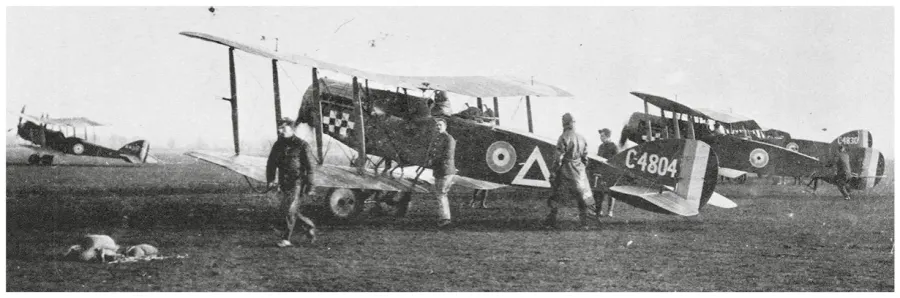
Sweat beaded under my leather flight helmet. I’d trained for these moments. A German single-seat pursuit plane, sitting defenseless under my nose, and the new Vickers twin machine guns rested in front of my cockpit, just offset, begging to be put to use.
Pull the trigger a quarter of an inch—that was all it took—and I’d open my scorecard at long last. The boys on the ground would welcome me back a hero.
But I had never killed a man, even after two years at war. I was cursed.
At first, it was natural. Every soldier enters the war without a kill, and each man looked forward to the day, macabre and twisted as it may sound. Some, the foolish ones, looked forward to it like a birthday or a ballgame. Others looked forward to it with dread like a trip to the dentist, but we all looked forward to it in some way.
Because we all wondered. The questions were relentless: Will I freeze up? How will I do it? What will it feel like when I stick a bayonet through a German and save the world?
Precious few of us wondered whether we’d be the ones left dying slowly in a trench or trying to crawl from a ravaged tank or burning fuselage.
And now, with a pull of my trigger, I could wonder no longer. I only had to bring myself to squeeze my finger a quarter inch.
After a time, it got awkward for those of us still unsullied. New boys coming over to the war would ask how long we’d been out here—then inevitably for our number. This was especially true among pilots, who reveled in their records of downed planes. Every pilot knew two numbers: their confirmed kills and the true number of their kills.
My two numbers were the same. Zero.
I shifted my hands nervously on the joystick. Come on, Marcus. Take the shot, already.
Before long, the other soldiers talked about me as if I had the influenza, and each had their own prescription for me to bag my first Boche. Lead your gun to take distance and speed into account. A swig of bourbon doesn’t do any harm. Wait to shoot until you’re sure your rounds will strike the kill box on the enemy’s fuselage.
As if I didn’t know.
Then the tips melted away, replaced with clumsy explanations that somewhere I’d been cursed. And that belief inspired them to see me with rage-inducing reverence.
Marcus, take the damn shot.
Descending from above as Luf had taught me, cloaking my Nieuport single-seater in the sunlight, I had settled in behind this poor German pilot like a cat in the night.
But like always, my brain would not stop thinking.
Why hadn’t he seen me? The idiot. The foolish idiot. Was he a new pilot? Had he not been trained properly? Didn’t he know that you must always look about you, scan the sky, pay close attention to those terrible blind spots?
My rudder pedals protested against my feet, and the joystick jostled as the wind caught my wings and rudder. Nature tried to pull me off course, tried to stop the violence before it happened.
Just a squeeze, little German. That’s all it will take, and you will die. If you’re lucky, one of the machine gun rounds will hit you, so you don’t fall in flames with your machine. The flames would lick your skin and bubble it and the worst fate you could imagine would be to survive the crash.
A quarter inch. That’s all.
But I had never killed a man, no, not after two years at war.
Suddenly, the pilot shifted his head back and forth. He seemed to mock me. His engine screamed in my direction, taunting me, daring me.
It was all getting dangerous now. Every moment I hesitated, the risk grew. He was unlikely to be the only plane nearby. Even if he didn’t take evasive action, his comrades would find him and open fire on his pursuer.
The German pilot dipped into a gentle bank. He turned his head and must have seen the tip of my wing, because he turned again, fast now, panicked. His eyes met mine. I should have pulled the trigger then, in that moment when our eyes locked across the clouds and he knew I was there.
But I didn’t. For some reason, I couldn’t.
The German Pfalz dove and banked hard, giving me a brief glimpse of the two black crosses on its wings. I had missed the easy shot. If another presented itself, I could not hesitate again, but now it would be different. Now there would be honor in the kill. He had a sporting chance to beat me.
The plane flipped over several times, curving under me, changing direction before making its climb to get above my machine. I jammed hard on the stick and my Nieuport gave chase. The pull of gravity tugged at my face and insides as the diving speed of my aircraft built so I could propel it upward again. The Pfalz darted so quickly without fear, and it had already twisted around to climb beyond the aim of my machine guns.
We circled one another. I tried to match his movements, but I struggled against the hardiness of the nimble German machine. The Pfalz D.III was known for its sturdiness, its reliability in a dive and sharp turns. My Nieuport 28, new at the front, was a model thrown to the Americans because the French didn’t want it. My turns could not be as sharp as his, for fear the linen on my plane would pull away from the wing’s leading edge and fail.
Yet, I could not risk falling too far behind in this contest to get well above the other. Already he had begun firing his Spandau machine gun to prevent me from taking certain maneuvers. They all went wide as I clung to the strategic defense I’d been taught. These fighters could only shoot forward. If I could just stay clear of his nose…
But with every turn, the Pfalz’s heavy wings cut away pieces of my escape route. This couldn’t go on for too long. Though I hadn’t yet shot down a German, I had logged plenty of flying hours. But even experienced pilots could knock themselves unconscious from too much maneuvering.
I spiraled down and dove quickly, trying to sweep beneath him, but he followed me deftly. When I pulled up from the dive he was gone.
Gone?
No. I glanced now at a bank of clouds. He had disappeared into them. A dare and a peace offering. Follow me or go home. I stared at the white plumed wall. I had given this man his chance for a gentleman’s duel. The game was on. To turn back now—
I put a hand to my neck, grasping for a glass marble suspended there on a small chain, but I could hardly feel it through the padding of my flight suit and gloves. The movement was automatic, superstitious. What was it pilots said? When it’s your time, there’s no stopping it. Magic marble or no.
It was time for me to get my first.
I flew into the clouds after him.
When I emerged on the other side, I saw them. My quarry with two other German fighters, death waiting. They seemed to be laughing at me. Greedy American. You could have gone home.
Instinct took the controls, and I squeezed my trigger. But my guns hardly had time to sing before they jammed. I was defenseless.
No, no, no.
The three planes seemed to hang in the air, as if pausing to comprehend my dilemma. Then in a flash, they closed in.
I flipped my nose downward again and spiraled back into the bank of clouds for cover. I didn’t need to check if they were following. I knew they would be.
I only hoped I could get back to my squad mates. But between my chase with the Pfalz and my scramble to escape its reinforcements, I’d lost significant altitude. Unless my boys were searching for me below our assigned patrol, they might not see me. And besides, they might be busy with their own German warbirds.
The terrible sound erupted. The mechanical, uncaring rat-tat-tat of the German guns. Rounds came zipping through the air. I rolled and banked and clutched at the glass marble around my neck.
My hands shook. Gravity and terror assaulted my stomach. The Germans sailed after me, taking turns shooting off rounds. Ten. Twenty. Fifty. One hundred rounds. Any bullet could end my life. I could not stay clear of all their guns, so I crossed their noses in a sporadic pattern of twists and slides. Could I outmaneuver them long enough to exhaust their ammunition? Their fuel?
Psssht.
The sound of a round piercing the canvas of my plane was anti-climactic. There was no explosion. No fanfare. Just a hole now in the wing with air whistling through it.
My gut climbed into my throat, condensation clouding on my flight goggles. I tried to wipe them, but my training was running out my ears. Fear, a recurring and unwelcome guest, evicted the smooth, smart evasive maneuvers I’d been taught, and now I let the animalistic instinct of survival take control. My swerves grew more daring, pushing the Nieuport to its limits, unconcerned about how much the wings could take.
I needed to get back to the Allied line. If I could fly low enough, perhaps our anti-air guns could help me, or even our artillery or infantry machine gunners.
My panicked maneuvering impeded my forward progress, though, and it was slow going, punctuated with the zips of German rounds piercing the howl of the wind.
Two years at war. I could not die here.
A jolt on my right wing. Glancing over revealed the trail of holes in the canvas, not so neat as the first, less graceful. I felt that impact as if the French oak frames in the wings were my own bones.
I noticed the effect on the plane almost immediately. It did not respond as it had before, and now pushing the Nieuport’s limits wasn’t dangerous—it was suicide. But what else could I do? The Germans were competing now, each jockeying for position to claim my death on his scorecard.
The panic was as deadly as the German guns. My number was still zero. I had not yet claimed that hero’s honor I’d left home to achieve.
Could I stomach a crash landing on rough terrain? Perhaps they would count the downed plane and leave me alone. But I could not crash yet. I was still in German territory. The line was visible, but I was flying dangerously low.
My vision soon clouded with the explosive rounds of anti-aircraft fire.
Rounds from behind. Rounds from below.
I had no choice. I had to climb or Archie on the ground would blow the Allied colors on my wings to bits.
I yanked back on the stick and adjusted my angle before banking into a wide turn away from the approaching battery—forty-five degrees to the left and shallow enough so as not to flash the tops of my wings at my pursuers. It’d be an easy target.
A round fizzed by my head, close enough to take my breath away, but soon they had flown straight past. They split in different directions on their re-approach.
Climb, Marcus. Climb. At least enough to give yourself a better chance against the ground fire.
My plane jerked behind me as another burst of fire poked a few holes in my fuselage. My thoughts drifted to my mother. The little stack of my father’s unopened letters in my luggage.
Their boy downed in God-forsaken Toulon without so much as a single victory, not a single bad guy nabbed in all his time away.
Ahead of me, I thought I saw my reflection, my plane climbing into a suspended pool of still water, breaching the veil separating life and death.
But no. It was Campbell!
His propellor dove straight toward me, and I barely had the sense to alter course before the two machine guns mounted in front of his cockpit blazed to life.
I swung my plane around just in time to see Uncle Sam’s top hat painted on the side of Campbell’s plane. I regurgitated a burst of air, sweet relief. I had unknowingly masked his attack, and the Germans scattered. I took advantage of the opportunity to continue gaining altitude and circle back to give him some much-needed help. Surprise or no, one pilot against three weren’t odds anyone liked.
Not that it stopped men like Campbell or Luf from trying.
A flash of light burst to my left, and I glanced over in time to see a Pfalz, my Pfalz, the one I had so thoughtfully refused to engage, catch fire—a terrible and awesome byproduct of Campbell’s enthusiasm. The plane dropped as the pilot panicked. I banked to see it play out, watching the man’s desperate dive unquestionably lose control and spiral to the earth.
A victory for Campbell.
My breath caught in my chest. Ironically, being in the air made it harder to breathe, and the relief hardly had fuel to swell.
Two on two now, and that changed everything. The Germans resorted quickly to evasive team maneuvers. I recognized the patterns we saw in many German pilots. The machine gun fire calmed, the pilots now reserving rounds for sure shots. We didn’t give them any.
As we danced around one another in the sky, a few more of our boys joined the fight from their nearby patrol. In less than a minute, the remaining Huns turned away to retreat.
We lined up to pursue. If we closed the distance quickly, we could count two more German planes out of the Kaiser’s service. But as I settled in between Campbell and Winslow, they glanced over and noticed the state of my aircraft. There was no hesitation. They signaled to turn home immediately.
I flushed bright red but followed.
Service in the air was nothing like what I’d seen on the ground. Each machine, each pilot, was precious, and it wouldn’t do to take unnecessary risks. After all, Campbell had already claimed a victory. Better to bring home the whole squadron and fix up a plane to fight another day under more favorable circumstances.
But no one—not a single pilot I knew—ever liked his comrades to make up for his lack.
I glanced at my guns. Jammed and harmless. My heart still hammered at over a hundred rounds per minute, but I had a good half hour to calm it down before we landed at Gengoult—thirty minutes to convince myself I’d never been afraid.
Chapter 2: Enhanced Repair Measures
Jane
In dreary doubtful waiting hours,Before the brazen frenzy starts,The horses show him nobler powers; —O patient eyes, courageous hearts!-Julian Grenfell-
No one else wanted my step ladder.
The other mechanics jealously guarded theirs as if they were made of gold. The one left to me, the first woman to work alongside them fixing up planes in Croix de Metz, was said to wobble. In fact, several mechanics had fallen over and earned nasty bumps and bruises that made the physically demanding job of fixing things all the more difficult.
None of them wanted a woman to succeed beside them. It would make them look less proficient, earn them even greater scorn from the pilots who took their projects into the sky.
So they gave me the wobbly step ladder.
But the thing about wobbly step ladders is that they simply need some good advice from someone who cares. So, for the first week I came into possession of my step ladder, I cleaned it for half an hour each night and spoke to it the way no one speaks to step ladders.
Eventually, its confidence grew, and its wobbles decreased until it was mostly reliable.
But as I worked away under the cowling of one the 94th Squadron’s Nieuport 28 single seat fighters, my step ladder regressed into bad habits.
“Steady now, Beatrice,” I said calmly. “At times, we’re all tempted to revert to old ways. But we cannot fit into past flaws any better than we can wear worn out boots.”
And with my comments, I either balanced myself better, or my step ladder stopped wobbling of its own accord. It’s difficult to say which happened.
“Hey, Jane! How’s it going over there?” A voice drifted from the ground behind me up and into my work. I took a steadying breath.
“Just fine, thank you,” I called back without turning.
“Will you be much longer?” The voice belonged to another new mechanic: given name Steve, surname A-Perpetual-Pain-in-My-Side.
“I’m working on the fuel line. This one has cracked, so it might be some time still while I fix it.”
“How do you plan to fix a cracked fuel line? Magic powder?” That was Steve’s friend, Brady. His ugly laugh was a testament to his facial features.
“Hey, now,” Steve replied, “she’s not going to use magic powder. She’ll probably just ask the fuel line to stop being cracked, please.” Steve tried to adopt an accent older than the American state he hailed from. It sounded like a drunk Welsh teenager doing his best at first year of preparatory school. But they both laughed all the same.
“If you could move along, I would appreciate it. I have a lot to do here.” I turned on them with a glare.
“Aw, come on, Steve. You’ve got her all upset.” Brady ran a hand through his wavy hair. There wasn’t much to like about his face, but his hair was his pride and joy. He kept it a little longer than he was allowed and took every opportunity to show it off.
“She’s only sore because her boy is up in the air,” Steve replied. My face flushed. Beatrice wobbled in anger.
“She sure knows how to pick a fella. Who knows? Maybe Gun-shy Markie will finally get a kill—or maybe he’ll finally be a kill. Hard to say.”
I clenched my jaw and descended from Beatrice, wrench grasped firmly in one fist. I approached them with all the menace I could muster.
“Marcus will come back,” I said with rigid jaw. I stared directly up into Brady’s shrewish face. “And he has more courage flying up there than you will ever have.”
Brady’s lips twisted into a smile.
“You see how riled up you gotta get to give me a lick of attention?” he asked with a mischievous grin. He nodded. “Tell me, now. You and Marcus, you got something there of a romantical sort?”
“Of course not,” I replied, still considering how I might use the wrench to worsen his knobby cheekbones.
“Then why not come into town with me this weekend? I’d love to take you for a spin. I’m about tired of all the weepy-eyed widows waiting for us over there.”
“How dare you,” I growled.
“Watch it now, Brady. She might cast a spell on you,” Steve said with a chuckle.
I let the comment sink in, watched his eyes as he slowly worked himself up into believing I might. It had taken me some time to embrace the benefits of my reputation, but they were there. After many long seconds, Brady lost his courage.
“Invitation stands, Jane,” he muttered. He gave a not-so-subtle thumbs up to Steve, and they started off toward the mess. Then, he called over his shoulder, “Maybe a little loving would solve that frowny face.”
I dropped the wrench and satisfied myself with pulling out a clump of his beautiful hair.
I was late to lunch. When I walked in, I ignored Brady, Steve, and their cohorts scowling in the corner and collected my food quickly before looking for a spot to eat by myself. I was used to eating alone, at least when Marcus was on duty. My mother would be surprised to learn that the seclusion didn’t bother me. I had come to the aerodrome on request of Major Raoul Lufbery as a specially skilled mechanic, arriving with eyes wide open to how I would be received.
Still, I found the social groups that naturally formed around the airbase amusing. Mechanics tended to eat with other mechanics. Pilots ate with pilots. But today, the women at a table in the corner beckoned me over to join them.
For me, solitude was expected. This invitation was not.
I paused before heading in their direction. I was friendly with the girls that worked at the base, but rarely had it earned me an invitation to sit with them. There weren’t scores of us at the aerodrome—only a handful. Some worked as cleaners, some as cooks, the petulant one with the raised nose worked in intelligence.
I was the only mechanic of my gender, at least here.
“Jane, sit down,” said the hen. Flora was her name, from Cornwall. “We women must stick together.”
I swallowed a snort. Seldom had I seen women truly stick together. And seeing as this was one of Flora’s rare, irregular attempts at any interaction between us, her comment did nothing to warm me.
“That’s very kind of you,” I managed as I sat down.
“Oh, it’s nothing. Isn’t it, ladies?” The gaggle beside her nodded and clucked. Lunch with ladies meant questions and talking. Under different circumstances, I’d hesitate to accept this invitation. But Marcus was still on patrol in the sky, and I’d welcome any distraction. Gently, I touched the glass marble hanging around my neck beneath my jumpsuit.
“They don’t do you any favors in the wardrobe department, do they?” Flora said. The other women returned to their sets of private conversations.
“Blouses, skirts, and grease don’t get along well,” I replied, dropping my hand to pick up my spoon.
“I can’t imagine they do,” Flora replied. “I have to commend you, Jane. I’m embarrassed at my luxury working in the intelligence office when I see the muck under your fingernails.”
My mucky fingernails brought soup to my mouth before I replied.
“Well, sadly, not all of us can help the war effort by talking on the telephone.”
Flora smiled tartly.
“No, some of us have to go about servicing the planes and the men that fly them.”
I tried to ignore Flora’s comment. Inside, I knew what women were capable of—how quickly we could turn on each other when threatened. I tried to turn this cynicism into a shield. But Flora lived to sit atop the social ladder, and her opinion reflected the belief to which the others likely subscribed.
So despite myself, her quips pierced my defenses. It was too much. Every time Marcus went into the air (and he did so often) it was too much. But not for the reasons everyone assumed. I stared down at my bowl, unwilling to give Flora the satisfaction of seeing me cry.
“Oh, don’t be like that,” Flora said. “I didn’t mean to get nasty. You don’t do yourself any favors, you know. Rumors circulate that you’ve taken to witchcraft. And being attached at the hip with one of the pilots isn’t an endearing look, either. The truth is most of these women are afraid of you. They wouldn’t know what to say at all if they found themselves alone with you for a stretch of five minutes.”
“I see,” I replied. “It must be your responsibility as an intelligence operative that has gifted you the social savvy to speak with me so freely.”
She scowled, and we fell into uneasy silence. I wasn’t the only one that experienced the stress of war. We all struggled with fear when a pilot went up. Dread. Anxiety. A whole patrol had been gone since late that morning. We mourned even the pilots we disliked.
People like Flora used this pain as a motivator to distance herself from everyone. Part of me envied her that wisdom.
I clutched the glass marble around my neck.
“Turner!”
A voice called to me across the mess. The compacted figure of Major Lufbery beckoned to me, hand ever at an acute angle, holding a phantom cigarette when a real one was unavailable.
“Excuse me,” I said, happy to have a reason to leave Flora and her flock for a real distraction. Without glancing backward, I knew they stared as I walked away.
“Yes, Major?” I asked when within earshot. He turned with an invitation to follow him out of the mess.
“Do you have that fuel line fixed?” he asked.
“Not yet, sir. It will likely need to be replaced. Do we have a spare?”
He grimaced. “Jane, if we had a spare, I’d have asked another mechanic to look at it.”
“I see, sir. You are hoping I can…”
“Come up with something creative,” Lufbery finished.
I turned the idea over in my head.
“You may overestimate my abilities, Major. I can’t simply conjure up magical weldings.”
He smiled, his eyes squinting.
“You can’t, huh?”
“You know I can’t. Whose plane is it?” I asked.
“Huffer.”
I paused. Most of my time went to patching up Marcus’s plane. Lufbery had officially assigned me to him. But occasionally, he requested that I work on other discreet repair jobs. It didn’t endear me to the assigned mechanics. But Lufbery had discovered my peculiar aptitude and method for repairs back at Villeneuve-les-Vertus aerodrome, the training base for the 94th.
Major Huffer was the official commander of the unit, but Lufbery was a war hero, having flown with the Lafayette Escadrille since the early days of wartime aviation. Most of the pilots looked to him for leadership.
“I see. And the commander being without a plane is never a nice thing,” I said carefully.
“Well, I’m not giving him mine. If he’s not going to be careful about how he uses his switch to control his engine, let him be grounded.”
“You think the fuel line cracked because of misuse?” I asked.
“Don’t make me say it out loud, Jane. But if one of the younger pilots cracked his line by switching cylinders the way he does, I’d have a serious conversation with him.”
We stopped as we neared my motorcycle, a Royal Enfield that I used to get around the base quickly. It made me grateful that I was assigned a jumpsuit and not a skirt.
“Well, as I’ve told you, magic—”
“Enhanced repair measures.”
“Very well, enhanced repair measures have a great deal more to do with the relationship between the pilot and his machine than some silly words one might say to try and fuse a cracked copper tubing.”
Lufbery nodded and searched for a cigarette. I waited for him to dismiss me. He didn’t.
“But you already knew that,” I said.
He lit his cigarette and took a leisurely drag. “I may remember you saying something about it.”
I smiled. “And you know that Major Huffer’s capacity to effectuate any enhanced repair measures is… limited.”
“I suspected as much.” He shrugged.
I swung a leg over the Enfield. “Thank you for the assignment,” I said. “It was an effective distraction while Marcus was out. Officially, I know that is beyond the scope of your concern and had nothing to do with why you assigned it to me.”
“Nothing at all.” Lufbery’s smile was contagious. There was no doubt as to why his pilots liked him. He cared about his friends and wasn’t afraid to turn protocol on its head to ensure safety, efficacy, and respect.
I went to start my engine, but the major put a hand on my arm.
“You and Marcus are close,” he said.
I nodded. Since Vertus, I’d been afraid that command would separate Marcus and me. The romantic rumors that circulated about us did very little to ease that anxiety.
“He’s important to me, too. He’s different, you know, from the others.”
“I know.”
“He doesn’t go into town. He doesn’t talk about the Germans the way the others do. He still hasn’t opened his scorecard.”
“There are plenty of pilots who haven’t yet downed a plane,” I retorted, unaccustomed to having to defend Marcus from Lufbery.
“I’m not critiquing him,” the major said. “The opposite. You know, Jane, this war has cost so much. Taken the lives of so many men. Some of them were never meant to be soldiers, and there’s nothing wrong with that. In fact, it’s something worth protecting.”
I furrowed my brows.
“May I speak candidly?” I asked.
“I have. You can, too.”
“That notion is ridiculous. You can’t protect anyone at war, and you know that much better than I do.”
Lufbery’s slack lips tightened across his face.
“Still, it might be worth trying,” he said. I must have rolled my eyes because he continued in a hurry. “How old do you think I am?”
“What kind of question—”
“How old?”
I studied his features and puzzled. He had creases in his face. His eyes sat deeply, and they cast themselves about lazily the way my father’s did in the morning before tea. His body moved sluggishly, fatigued even when rested.
“Perhaps high thirties. Maybe forty,” I said.
“I just had my thirtieth birthday.”
I blushed.
“War ages people differently than during peace time,” I stammered, trying to correct myself. “You’ve been at combat for years.”
He watched me scramble to recover before responding, “I met Marcus when he was nineteen years old. Before he joined up with the Lafayette, they had him driving ambulances at the front where he saw things that’ll peel the skin from your eyes.”
He put his cigarette to his lips, perhaps pushing away similar horrors. I ignored the smoke, even though it had always made my eyes burn. Marcus was only three years my junior.
“He wants to be the next great combat pilot. He was a teenager when the war started, and I don’t have to tell you what the stories newspaper men write can do to young kids who don’t know any better.”
I fanned the smoke gently away from my face.
“You don’t want him to be the next great combat ace?” I asked. He dropped the rest of his cigarette on the ground and ground it into the dirt with a crunch.
“Maybe I’m just tired of seeing the war have its way with the boys it seduced,” he said. “If something deep inside of Marcus won’t let him shoot another man—now wouldn’t there be something strangely pretty about that? If he went the whole war and never had to take a life?”
“If you feel that way, why did you recruit him for America’s first pursuit squadron?”
“Because he’s a good pilot, and he deserves to become a combat ace if he wants to. We need combat aces, and for the sake of the war, I have to put my personal feelings aside and treat him like I would anyone else. It might cost him his life. It might cost him something more. That’s the price of leadership. But if it were possible to protect him, I think there might be something in that.”
If anyone in the world understood my friendship with Marcus, it was Lufbery. But he’d never spoken about his understanding so openly. I found a great relief flooding into my chest on hearing his words.
“Why are you telling me this?” I asked.
“There’s something rumbling from command. Something’s coming. I just wanted to warn you.” He squeezed my arm. “Better see what you can do about Huffer’s plane. At least let me tell him we’ve tried to fix his fuel line. And don’t worry. Marcus will be down within the hour. I’m sure of it.”
He turned and walked off, puffs of smoke from a newly lit cigarette marking his path in the air behind him.
Thanks for reading this sample. To keep reading purchase a copy of Drops of Glass at the link below: